Immune Systems Research
On the Timeline page, I describe a one-page document I bring to doctors' appointments: what happened, in order, what changed, and whether it recovered.
That is the caregiver's version of the question behind this research.
A laboratory result is a snapshot of where a person is. A trajectory shows how they got there. My research asks whether the trajectory carries information the snapshot misses, and under what conditions.
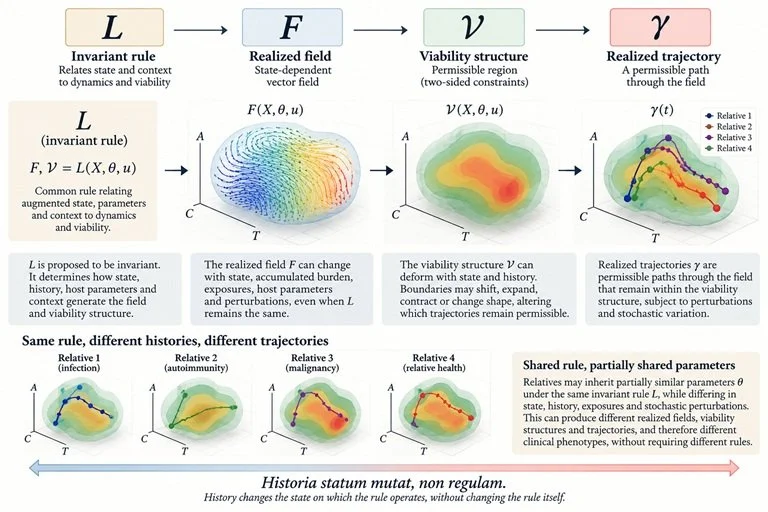
Historia statum mutat, non regulam.
History changes the state, not the rule.
At molecular and cellular scales, history-dependent state is well established. Immune memory, differentiation, epigenetic remodeling, trained immunity, and exhaustion are examples of biology retaining information about what happened before.
My hypothesis is that this same principle may be visible at the phenotype level.
Past events may leave an immune system in a different state without requiring the underlying rules to have changed. If so, two people who look similar in a snapshot may have different futures because of histories we haven't represented.
Bringing Translational Structure to Complex Immune-Mediated Conditions: The ACT (Activation–Constraint–Tissue Context) Framework for Divergent Phenotypes
https://www.frontiersin.org/journals/immunology/articles/10.3389/fimmu.2026.1866922/full
Published by Frontiers in Immunology Oct 22, 2026.
ACT represents complex immune phenotypes as trajectories through a partially observable state space using three reduced axes: activation, constraint, and tissue context. Accumulated injury, or burden, represents history that may shape what happens next.
The question is simple:
Does knowing the trajectory tell us something that knowing the present state alone does not?
Trajectory as Phenotype? A Conjecture on Permissible Phenotype
Working paper, 2026. Zenodo. DOI: 10.5281/zenodo.22919710
Version 2 Draft manuscript published Oct 10, 2026
The follow-on conjecture asks a harder question: if phenotype-level dynamics are history dependent, might apparently changing rules actually reflect an incomplete representation of state?
If adding information from the trajectory improves prediction beyond the present state alone, then apparently changing dynamics may become representable as one invariant rule operating on an augmented, history-dependent state.
If it doesn't, the conjecture fails.
So the bridge I am asking researchers to test is:
Molecular biology: history changes state.
My hypothesis: the same principle may be visible in phenotype.
My conjecture: enough trajectory information may reveal an invariant rule governing what can happen next.
LFG: A Toy Law Falsification Generator for Testing Invariant Dynamical Models
Computational notebook, 2026. Zenodo. DOI: 10.5281/zenodo.23287050
Published October 10, 2026. Public abstract; restricted experimental files.
LFG (Law Falsification Generator) is an exploratory Python testbed developed to address a methodological challenge raised by the Permissible Phenotype Conjecture: how can we determine whether an inferred governing law is actually wrong?
Developed collaboratively with OpenAI's GPT-6, LFG tests supplied stochastic transition laws against synthetic worlds, including worlds that appear similar but operate under different dynamics. The prototype incorporates numerical certification, empirical error calibration, controlled counterexamples, and explicit reporting of failed tests.
The initial experiments demonstrated that a proposed law could predict outcomes beyond those used to fit it. Subsequent testing exposed significant limitations, including inadequate sensitivity to subtle differences between laws. Those failures remain part of the documented research record.
The question is simple:
If two different laws can explain what we observe, what experiment would allow us to reject one of them?
LFG does not discover governing laws or validate the Permissible Phenotype Conjecture. It is an early computational effort to develop the methods needed to challenge candidate laws rigorously.
So the progression is:
ACT: Can trajectories explain divergent immune phenotypes?
Permissible Phenotype: Might those trajectories be governed by an invariant rule?
LFG: How do we test whether a proposed rule is genuinely invariant—or merely one of several explanations consistent with the observations?
The New Turing Test: A Methods Demonstration in Irreversible History and Permissible Futures
Methods demonstration, 2026. Zenodo. DOI: 10.5281/zenodo.23405736
Published October 15, 2026. Preprint. Five computational experiments.
The New Turing Test extends the question of history-dependent trajectories beyond immunology into artificial intelligence. Rather than asking whether a machine can convincingly describe human experience, the experiments examine whether irreversible changes to an artificial system's available futures alter its subsequent decisions.
The methods introduce a governing-class architecture, G = (ℒ, Φ, Θ, κ, 𝒱, U_adm), and use controlled computational experiments to distinguish a system being told it is vulnerable from a system facing actual constraints on its future capabilities.
The experiments examine decision-making under irreversible consequence, including how systems respond when preserving an available future conflicts with immediate exploration or reward.
These experiments do not establish consciousness or subjective experience. They test a narrower, observable question: whether changes in permissible futures produce measurable differences in behavior.
The question is simple:
Can we distinguish a system that represents irreversible consequences from one whose own future decisions are constrained by them?
Read the accompanying essay: The New Turing Test
LIE: A Law Identification Engine for Heterogeneous Trajectories
Working paper, software, and reproducibility archive. Zenodo DOI: 10.5281/zenodo.23821973
Published October 30, 2026. Open access. Scientific code licensed MIT; manuscript and documentation licensed CC BY 4.0.
The Law Identification Engine (LIE) addresses an inverse problem arising from the Permissible Phenotype Conjecture.
If governing laws (L) produce state-dependent dynamics (F), constrained permissible futures (V), and realized trajectories (γ), can we work backward from observed trajectories to identify the governing rules?
And, critically, how can we distinguish a genuinely shared law from a different law that happens to produce similar observations?
LIE tests this problem using stochastic models and synthetic families with varying individual histories and characteristics.
In its completed Campaign 2.0, LIE evaluated 960 study rungs, including 352 near-different-law and 120 shared-law lineages.
When family evidence increased from 24 to 48 families, correct guarded identification of near-different laws rose from 15.1% to 55.4%, an improvement of 40.34 percentage points. Recognition of genuinely shared laws reached 96.7%.
But the experiment also exposed an important limitation: twelve incorrect shared-law conclusions retained posterior probabilities of at least 0.99.
The question is simple:
If two governing laws can explain what we observe, what evidence allows us to identify the correct one—or recognize that we cannot yet distinguish them?
LIE is a human-directed computational research instrument, not a discovered biological law or validated clinical tool. Its completed evaluation uses synthetic worlds and a restricted class of stochastic governing rules.
The scientific code, experimental configuration, supporting documentation, and compact results are publicly available for inspection, reproduction, and independent challenge.
Test This Work
These are questions to be tested, not answers to be accepted.
If you work in systems immunology, dynamical systems, trajectory modeling, observability, or longitudinal clinical data and see a way to test, challenge, falsify, or improve this work, I would be grateful to hear from you.
This research is personal and independent; it was not commissioned, funded, sponsored, reviewed, or approved by Accenture, and the views expressed are solely my own.
Jeff Lorsung
ORCID: 0009-0009-9775-2965
jeff@jefflorsung.ai