
Science, Faith, and the Logos
Science, Faith, and the Logos
I mention elsewhere that I am Catholic. I have never considered science and religion incompatible. To me, they are different ways of reaching for a common truth.
Science asks how the world works. It has shown us something remarkable: once the table is set—once matter, initial conditions, and governing rules exist—extraordinary complexity can unfold naturally. Stars form. Chemistry emerges. Life evolves. Eventually, conscious beings appear who are capable of asking where any of it came from.
I do not find that threatening to faith. I find it beautiful.
Perhaps God's act of creation need not be imagined as the individual assembly of every thing that would ever exist. Perhaps the breath of God breathed into existence a creation capable of unfolding according to an intelligible order.
That is not a particularly modern idea. Augustine wrote of rationes seminales—“seed-like principles” within creation capable of unfolding in time. Aquinas later distinguished God as primary cause from the genuine secondary causes operating within nature, while understanding creation as continuously dependent upon God for its existence. Natural processes, in that tradition, are not alternatives to creation. They are part of how creation works.
And the image of God's Word and breath belongs to scripture itself:
“By the word of the LORD were the heavens made; and all the host of them by the breath of his mouth.”
— Psalm 33:6, KJV
All of this brings me back to the opening of the Gospel of John:
“In the beginning was the Word, and the Word was with God, and the Word was God.
The same was in the beginning with God.
All things were made by him; and without him was not any thing made that was made.”
— John 1:1–3, KJV
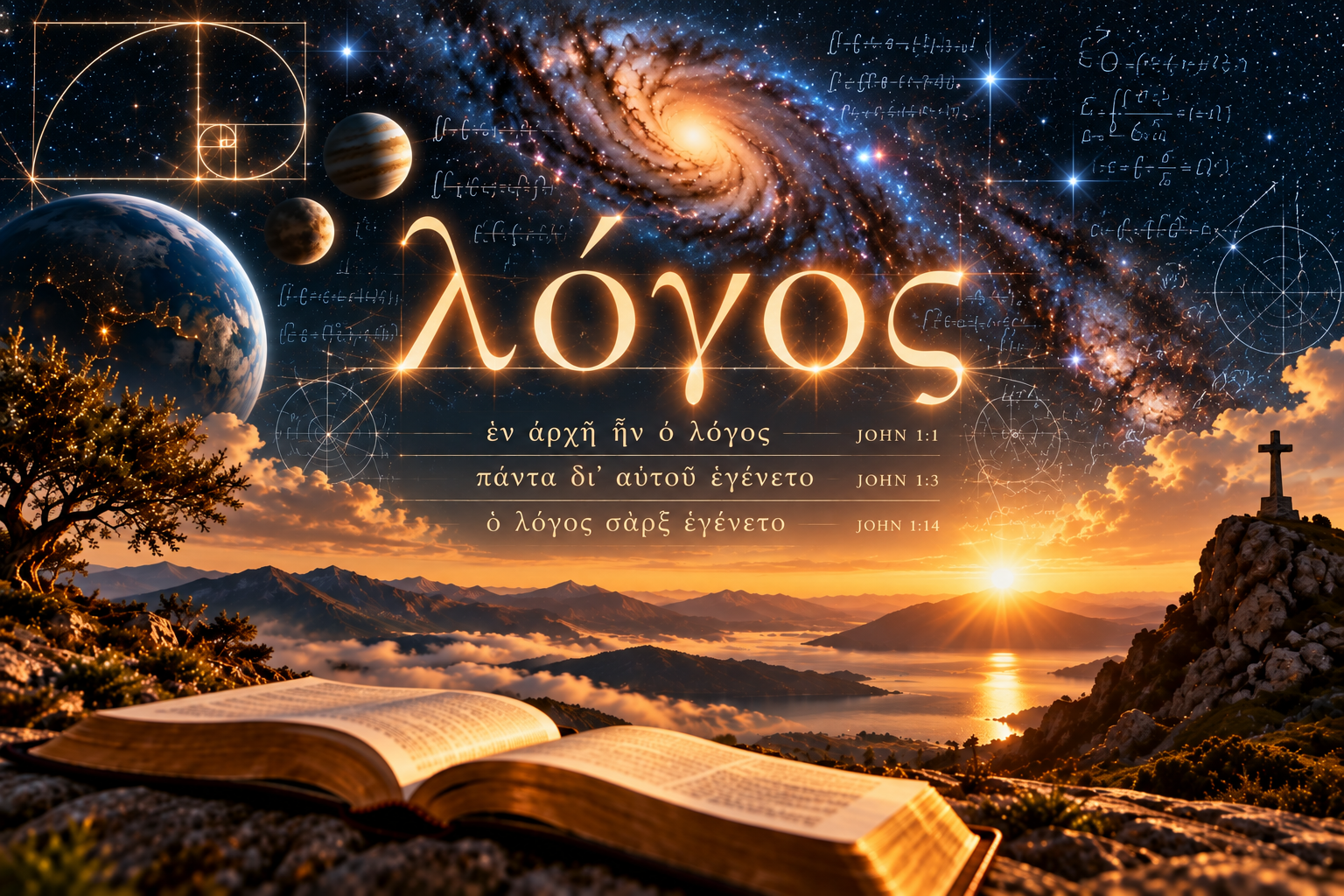
The English word Word translates the Greek λόγος — Logos.
That matters.
Logos can mean word, speech, account, reason, or explanation. It also belonged to a Greek intellectual tradition in which logos could carry ideas of reason and intelligible order. Readers steeped in Jewish scripture would hear something else as well: the creative Word of God. Genesis begins with God speaking, and creation follows.
Those worlds had already encountered one another before John. Philo of Alexandria, a Jewish thinker writing in Greek in the first century, had used Logos extensively while bringing Jewish scripture into conversation with Greek philosophy. He could describe the Logos in extraordinary terms—as God's image or firstborn—but John will ultimately go somewhere more radical.
There is something important in John's choice of verbs.
John begins:
Ἐν ἀρχῇ ἦν ὁ λόγος
In the beginning was the Logos.
The verb is ἦν (ēn): was. John does not say that the Logos came into existence. At the beginning, the Logos already was.
Then the verb changes:
πάντα δι’ αὐτοῦ ἐγένετο
All things came into being through him.
Here John uses ἐγένετο (egeneto), from a verb meaning to become, to arise, or to come into existence.
The distinction is striking.
The Logos was.
Creation became.
The traditional King James rendering—“all things were made by him”—is beautiful, but “all things came into being through him” allows that contrast to remain visible.
And then John does something extraordinary.
The Logos Becomes Flesh
A few verses later:
“And the Word was made flesh, and dwelt among us…”
— John 1:14, KJV
The Greek reads:
ὁ λόγος σὰρξ ἐγένετο
The Logos became flesh.
John returns to ἐγένετο.
This is the step beyond philosophical abstraction. The Logos is not merely divine reason, image, or intermediary.
The Logos was.
Everything else came into being through the Logos.
And then the one who was became flesh.
The eternal enters the order of becoming—the very order through which everything else came to be.
John is not writing a scientific account of cosmology or evolution, and Logos does not literally mean a physical law, equation, algorithm, or dynamical rule. I would not pretend otherwise.
But I find the architecture of the passage profound.
If science discovers that increasingly complex forms can arise naturally from underlying rules and relationships, I do not see that as pushing God out of creation. It moves my question upstream—and perhaps deeper.
Why is reality ordered in such a way that anything can unfold at all?
Why should there be an intelligible universe, governed by relationships sufficiently stable that mathematics can describe them, science can discover them, and matter can eventually organize itself into beings capable of discovering those relationships?
For a Christian, John gives that intelligibility a name.
Logos.
And John does not leave the Logos as an abstraction.
The Logos becomes flesh.
Jesus.
That is why I have never seen a necessary conflict between science and faith. Science asks me to look carefully at what creation does, identify its patterns, test its rules, and discard explanations that fail.
Faith asks what those rules, that intelligibility, and our existence within them ultimately mean.
I see no requirement that one must defeat the other.
They may simply be different ways of reaching for a common truth.
In the beginning was the Logos.
Through the Logos, all things came into being.
And the Logos became flesh and dwelt among us.